Operational Training Unit
4 April 44 - 21 June 44
Gaydon England #22 O.T.U. R.A.F.
The O.T.U. was a step in British Commonwealth Air Training Plan that allowed airmen to train in an operational environment to prepare them for war. There were seven Operational Training Units in Canada during the BCATP. Located in the Eastern and Western Air Commands, airmen would be posted to an OTU to gain experience on operations before being posted to a battle squadron. Occasionally required to fly operational patrols, Canadian OTU's were held as less important than those located in Great Britain, where most BCATP graduates received their operational training.
During World War II an RAF station was built near the village of Warwickshire in
the UK. This was a standard three-runway airfield similar to a number of other
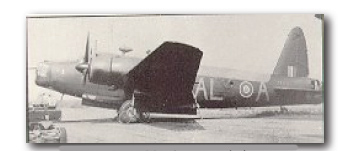
airfields nearby and was used mainly for training bomber crews, using Wellington Bombers or their training variants.
Wellesbourne airfield was home to the No.22 Operational Training Unit who
trained many aviation personnel, and is in fact still in operation as a private
airfield.
Gaydon had a large RAF base near the village that is now the Heritage Motor
Centre, and Baginton Aerodrome was an RAF fighter station. Today, it is known as
Coventry Airport and houses the Midland Air Museum.
April 4, 1944
Started Course
May 3, 1944
Took off at 11:05 with W/O Gauthier flying a Wellington in Gaydon England
May 4, 1944
Took off the next day at 10:55 with P/O Hastie again practicing cine camera
gun.
May 5, 1944
Practiced circuits for 45 minutes with F/O Smith, then flying to Wellesbourne
with F/O Desolla.
May 6, 1944
Taking a two hour trip to Ashborne and back with F/O Way.
May 7, 8, 9, 10, 12, 15, 17,18,1944
Going up two or three hours a day, practicing night interception, cine camera
gun, doing other special exercises. Spending most the time with F/O Smith.
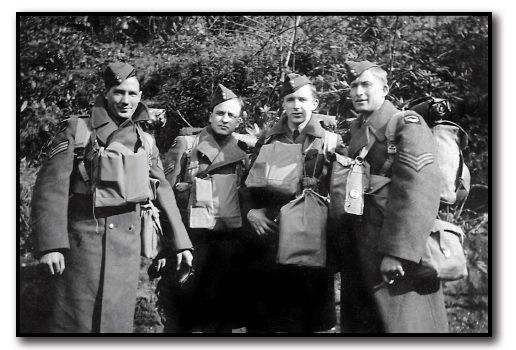
- Gibb at far left with R.C.A.F. friends
May 22, 1944
Taking his first night flying, doing circuits for 2 hours with F/O Stean.
May 23, 24,1944.
Doing more exercises
May 28, 1944
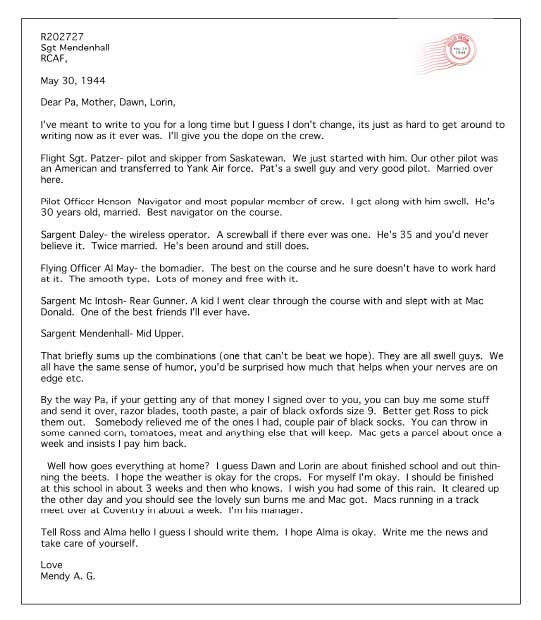
Meets up with F/S Patzer. That day they did 4 and a half hours of exercises
together. Patzer was a pilot and skipper from Saskatchewan. Married in England
and lived in Seafield, West Lothian, Scotland. He replaced an American Pilot who was transferred to the Yank Air force. Called him Pat. Gibb said he was a very good pilot. Patzer would soon become F/O and fly many missions with Gibb.
May 29, 30, 1944
Did more circuits
June 2, 7, 8, 10, 13, 14, 19, 21, 1944
More exercise hitting the bulls-eye on the 14. Flying with Patzer most of the
month of June. At the end of this period was given above average assessment.
Gibb’s total Flying time:
Day- 98 hours and 25 minutes Day
Night- 38 hours and 35 minutes
The commanding officer remarks were that Gibb was above average. His
application of sighting in the air was good and steady progress was being
maintained.
As a Fighting Controller he was above average, and very consistent. Cine films
show
steady improvement and progress. Said that Gibb was slow in learning but once he
absorbed his knowledge he retained it.
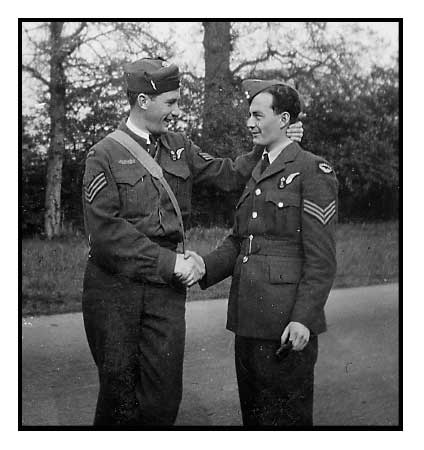
- Gibb at left